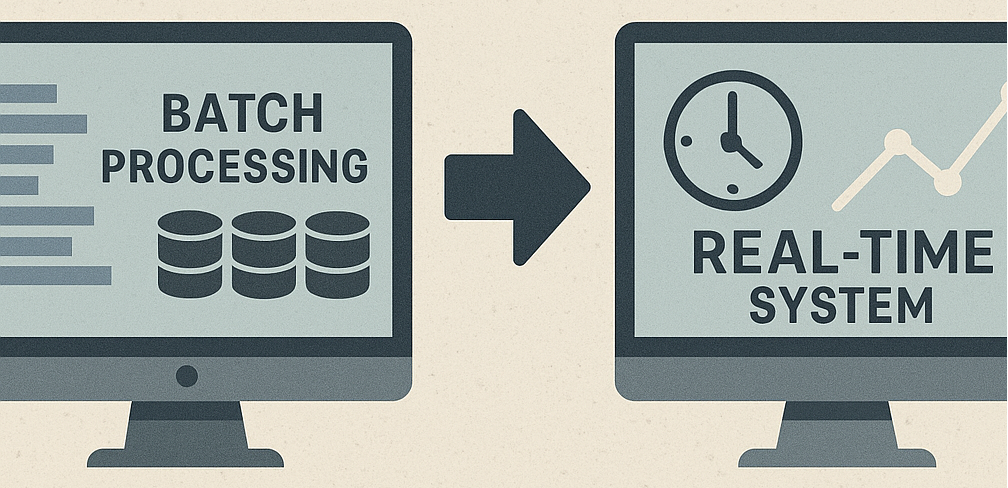
Hiya! If you’ve followed me and/or this blog for a while, you’ll know I love talking about data. I’ve spent my career helping organisations build data platforms, and for most of that time, the pattern has looked the same: pull data from somewhere, load it into a warehouse, transform it, and eventually surface it in a report. Rinse and repeat. We’ve got really, really good at this. It’s a pattern that’s been practised and perfected over years.
But here’s the thing — that data is already old by the time anyone sees it.
The Batch World We’ve Lived In
Traditional data engineering is fundamentally batch-oriented. You schedule a pipeline to run overnight, or every hour, or every 15 minutes. Data gets ingested from source systems, transformed through layers, and lands in a model that a dashboard can query. Think ODS, IDL, EDW. It works. It’s reliable. And it’s the foundation of most modern data platforms.
The problem is that the world doesn’t wait for your pipeline to run.
A machine on a factory floor starts vibrating abnormally. A patient’s vitals begin trending in the wrong direction. A shipment gets diverted. Stock prices react to breaking news. In each of these cases, waiting even five minutes before acting could mean the difference between a good outcome and a very bad one.
This is the gap that Real-Time Intelligence (RTI) is designed to close — and I think it represents a genuine shift in how we think about data loading and processing.
What the Shift Actually Means
The old paradigm says: collect data, then analyse it.
The new paradigm says: analyse data as it arrives.
This sounds simple, but it changes almost everything about how you architect a solution. Instead of scheduled batch loads, you’re ingesting continuous streams of events. Instead of running queries against historical data, you’re running queries against a live, constantly-updating dataset. Instead of surfacing insights after the fact, you’re detecting conditions as they occur and triggering actions automatically.
Microsoft Fabric’s Real-Time Intelligence workload is built around this model. Data flows in through Eventstream, lands in an Eventhouse (the analytical engine), gets shaped through update policies and materialized views, and can trigger automated responses via Activator — all in near real-time. You can visualise what’s happening right now through Real-Time Dashboards, and the whole thing sits on top of OneLake.
Why Should You Care?
Here’s a question we posed in a workshop recently: How does Real-Time Intelligence impact your daily life?
Think about it. When you track a delivery in real time and watch your package move across a map, that’s RTI. When an airline system automatically reroutes your baggage because a connecting flight is running late, that’s RTI. When a hospital monitor alerts nursing staff to a deteriorating patient before it becomes critical, that’s RTI. When fraud detection flags your card transaction in milliseconds, that’s RTI.
These capabilities aren’t new, they’ve been around in many industries for a while now. And the common thread across all of them is the same: the value is in acting on data while it’s still relevant, not after the window of opportunity has closed.
The AI Connection
Here’s the angle I find most exciting: Real-Time Intelligence isn’t just about operational efficiency — it’s laying the foundation for the AI era.
AI agents and GenAI applications are only as good as the data they’re grounded in. A copilot that’s making decisions based on yesterday’s data isn’t particularly useful for anything time-sensitive. An anomaly detection model that only runs once a day can’t catch problems before they escalate. Real-time data is what makes AI genuinely useful in operational contexts.
Fabric RTI is already moving in this direction. The platform includes Copilot integration, an Operations Agent, anomaly detection, MCP support, and Data Agent capabilities — all designed to work with live, streaming data. This is the infrastructure that lets AI move from answering questions about the past to acting intelligently in the present.
It’s More Accessible Than You Think
One of the biggest barriers organisations have faced with real-time data has been complexity. Historically, building a real-time pipeline meant stitching together half a dozen different tools from a very fragmented market — capture, transport, operational transforms, analytics, and agents all required separate products and specialist skills. The result was expensive, hard to maintain, and available only to organisations with serious engineering resources.
Fabric RTI changes that calculus. Because it’s fully integrated into the Fabric platform, you’re working within a single data estate with unified governance, OneLake as your storage foundation, and familiar tools like Power BI and Power Automate for visualisation and automation. You don’t need to be a streaming specialist to get started.
And if your data is in a legacy on-prem system — factories, grids, SCADA systems — Fabric RTI can work with that too, via integrations like Fusion Data Hub, Azure IoT Operations, and a rich ecosystem of connectors.
Where to From Here?
I’ve been spending a lot of time with RTI lately, and the more I dig into it, the more convinced I am that this is the direction the whole industry is heading. Batch will always have its place — there are plenty of use cases where it’s exactly the right tool. But the assumption that batch is the default and real-time is the exception is starting to invert.
For anyone on a Microsoft data platform, now is a great time to start exploring RTI in Fabric.
Stay tuned — and as always, if you want to chat about all things data, feel free to reach out!